










近期查看的产品
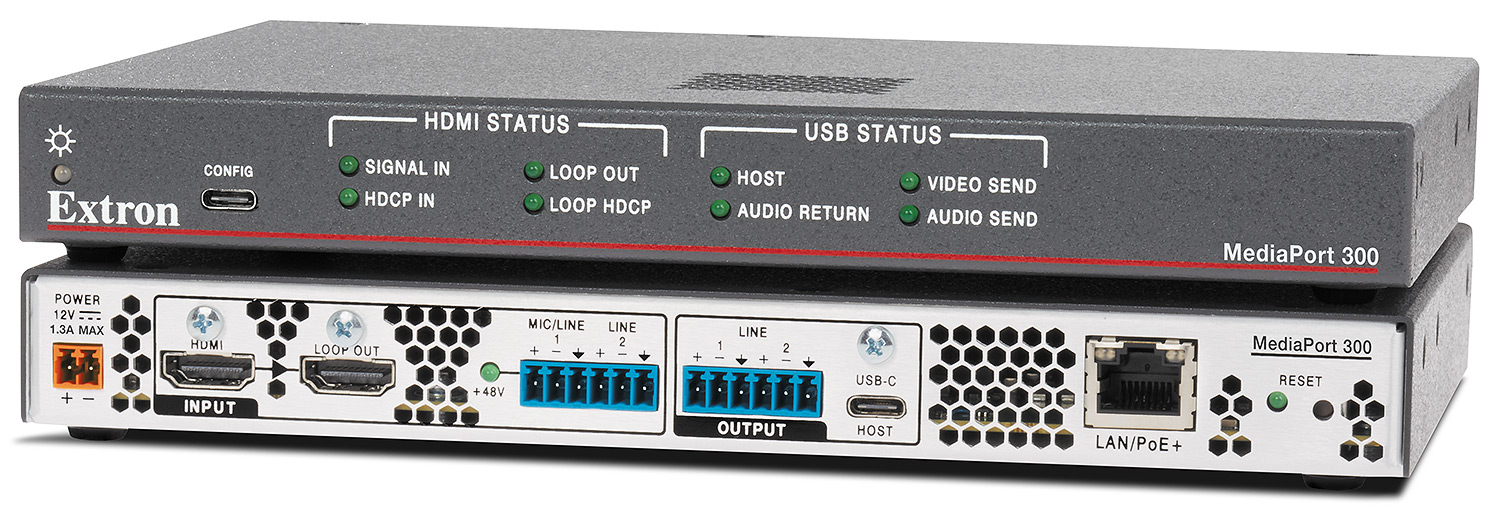
MediaPort 300
建筑工程规范
选择一个产品编号:
复制文本
已复制!
发生错误。请稍后重试。
MediaPort 300
- Provide an HDMI and audio to USB-C interface, for integration of an AV source or system with a computer in a soft codec videoconferencing application
- HDMI and audio to USB-C scaling bridge, with integrated audio control, video processing, a variety of analog audio I/O ports, and signal management for analog audio, HDMI embedded audio, and USB bidirectional audio
- Video Input Requirements
- Shall provide one (1) HDMI Type A connector for digital video signals with embedded audio
- Shall provide one (1) HDMI Type A connector for buffered loop-through with full 4K/60 4:4:4 support
- Shall support HDMI computer and video resolutions up to 4K/60 and 4K/30
- Audio Input Requirements
- Shall provide one (1) five-pole captive screw connector for mic/line audio
- Shall provide selectable +48 volt phantom power for a condenser microphone
- Shall support HDMI audio de-embedding for two-channel PCM audio
- Shall support two channels of USB audio from the host computer
- Shall provide analog to digital audio conversion at 48 kHz sampling rate with 24-bit resolution
- USB Interface Requirements
- Shall provide one (1) USB Type C connector for USB data and bidirectional 2x2 audio signals
- Shall support USB 3.0 standards
- USB 3.0 device connection shall appear as generic USB webcam and speakerphone to host computer
- Utilizes industry standard UVC - USB Video Class and UAC - USB Audio Class drivers
- USB video and audio content shall be compatible with popular Unified Communications (UC), Lecture Capture, or other USB streaming software
- Shall support the option to present as no USB host, webcam only, non-echo cancelling speakerphone or echo cancelling speakerphone, non-echo cancelling speakerphone & webcam or echo cancelling speakerphone & webcam to host computer controllable via external control system or configuration utility.
- Shall support configuration of USB resolutions and formats to enable optimization of quality and removal of incompatible formats.
- Audio Output Requirements
- Shall provide one (1) six-pole captive screw connector for balanced/unbalanced line level stereo audio
- Shall provide two channels of USB audio to the host computer
- Shall provide digital to analog conversion at 48 kHz sampling rate with 24-bit resolution
- Audio Device Requirements — Input to Output
- Shall provide a signal-to-noise ratio greater than 90 dB measured from 20 Hz to 20 kHz, at maximum balanced output, unweighted
- Shall provide a THD+N measurement of less than 0.03% measured at 20 Hz to 20 kHz, at maximum level
- Video Processing Requirements
- Shall provide processing and conversion of video from HDMI to USB encoded video for the host computer
- Shall provide scaled USB video output from 640x630 to 4K/30, determined by the soft codec
- Based on CPU usage and bandwidth conditions between near-end and far-end locations
- Shall provide aspect ratio control
- FILL mode – video image shall always fill the host computer’s screen or window without letterbox or pillarbox
- FOLLOW mode – video image on the host computer’s screen or window shall always preserve the aspect ratio of the input signals without distortion
- Shall provide image adjustments for brightness, contrast, H/V positioning, and sizing
- Shall provide storage and recall of video parameters and picture settings
- Automatic memories for each video input
- Save video settings and picture adjustments without user intervention
- Automatically recall settings when the same video rate is encountered
- The user may selectively enable or disable automatic memories
- Manual user presets
- Save picture adjustments
- User presets may be saved and recalled electronically via USB, or Ethernet
- Automatic memories for each video input
- Shall provide internal test patterns for calibration and setup
- Shall support the ability to display a user-supplied image file whenever no signal is present at the HDMI input
- Shall deliver USB streaming video output with MJPEG encoding
- Shall support MJPEG Compressed and YUY2 and NV12 uncompressed formats to support applications requiring higher frame rates and lower bandwidths as well as applications requiring precise detail.
- Audio Requirements
- Shall provide audio signal management and optimization for analog audio, HDMI de-embedded audio, and USB bidirectional audio
- Shall support AES67 Audio to enable connection to other AES67 and Dante enabled devices over LAN.
- Shall provide Audio DSP tools including gain, mixing, ducking, compressor, and parametric EQ
- Shall provide soft limit settings to define upper and lower limits on adjusting near-end and far-end audio levels
- Shall allow audio configuration and parameter adjustments through the product configuration software
- Shall provide real-time level meters for inputs and outputs in the product configuration software
- Shall provide user presets for saving and recalling DSP parameters
- Shall provide configurable AEC reference output to support external DSP based acoustic echo cancellation.
- EDID Requirements
- Shall provide automatic EDID management between the MediaPort 300 and an HDMI source
- Provide a set of pre-stored EDID files
- Support capture of EDID from any display connected to the HDMI loop-through
- Support user uploading of custom-generated EDID files
- Shall provide automatic EDID management between the MediaPort 300 and an HDMI source
- HDCP Requirements
- Shall provide HDCP-compliant capabilities on HDMI input and loop-through
- Shall provide selectable HDCP authentication for recognition by connected source
- Shall provide visual confirmation of HDCP compliance when encrypted content is routed to a non-HDCP compliant display
- Video output of a full solid green screen, black screen, or use image (user selectable)
- Control Requirements
- Shall provide (1) USB Type C connector on front panel
- Shall provide one (1) RJ-45 port on rear panel for Ethernet control
- Shall support 10/100/1000Base-T Ethernet
- Shall provide built-in Web pages accessible using a standard Web browser via Ethernet connection
- Shall support product configuration software via an Ethernet or USB connection from a computer
- Shall support reporting of hook status to a connected control system including on / off hook, mute, ring, and hangup.
- Shall accept serial commands sent over Ethernet
- Shall allow user presets to be saved and recalled using the product configuration software
- Power Requirements
- Shall be equipped with an external, universal AC power supply capable of supporting 100 - 240 VAC, 50/60 Hz power
- Output is 12 VDC, 1.5 A, 18 watts
- Shall be equipped with an external, universal AC power supply capable of supporting 100 - 240 VAC, 50/60 Hz power
- General Requirements
- Shall provide visual signal on LED indicators located on front panel for HDMI input and loop-through signal presence, HDCP status, plus USB signal presence for the host computer, video send, audio send, and audio return
- Shall provide visual signal on LED indicators located on rear panel for mic phantom power status, LAN activity, and reset function
- Shall incorporate flexible hardware architecture to enable feature upgrades and compatibility enhancements.
- Shall be a 1” high, half rack width metal enclosure
- Shall be rack mountable with optional rack shelf
- Shall be furniture mountable with optional mounting kit
- Shall meet regulatory compliances
- Shall meet safety compliances under CE, c-UL, and UL
- Shall meet EMI/EMC compliances under CE, C-tick, FCC Class A, ICES, and VCCI
- Shall comply with appropriate requirements of RoHS and WEEE
- Shall provide three years parts and labor warranty
- Video Input Requirements
- Approved device shall be the Extron MediaPort 300 (part number 60-1873-01); no alternates or equals.
- HDMI and audio to USB-C scaling bridge, with integrated audio control, video processing, a variety of analog audio I/O ports, and signal management for analog audio, HDMI embedded audio, and USB bidirectional audio
MediaPort 300
- Provide an HDMI and audio to USB-C interface, for integration of an AV source or system with a computer in a soft codec videoconferencing application
- HDMI and audio to USB-C scaling bridge, with integrated audio control, video processing, a variety of analog audio I/O ports, and signal management for analog audio, HDMI embedded audio, and USB bidirectional audio
- Video Input Requirements
- Shall provide one (1) HDMI Type A connector for digital video signals with embedded audio
- Shall provide one (1) HDMI Type A connector for buffered loop-through with full 4K/60 4:4:4 support
- Shall support HDMI computer and video resolutions up to 4K/60 and 4K/30
- Audio Input Requirements
- Shall provide one (1) five-pole captive screw connector for mic/line audio
- Shall provide selectable +48 volt phantom power for a condenser microphone
- Shall support HDMI audio de-embedding for two-channel PCM audio
- Shall support two channels of USB audio from the host computer
- Shall provide analog to digital audio conversion at 48 kHz sampling rate with 24-bit resolution
- USB Interface Requirements
- Shall provide one (1) USB Type C connector for USB data and bidirectional 2x2 audio signals
- Shall support USB 3.0 standards
- USB 3.0 device connection shall appear as generic USB webcam and speakerphone to host computer
- Utilizes industry standard UVC - USB Video Class and UAC - USB Audio Class drivers
- USB video and audio content shall be compatible with popular Unified Communications (UC), Lecture Capture, or other USB streaming software
- Shall support the option to present as no USB host, webcam only, non-echo cancelling speakerphone or echo cancelling speakerphone, non-echo cancelling speakerphone & webcam or echo cancelling speakerphone & webcam to host computer controllable via external control system or configuration utility.
- Shall support configuration of USB resolutions and formats to enable optimization of quality and removal of incompatible formats.
- Audio Output Requirements
- Shall provide one (1) six-pole captive screw connector for balanced/unbalanced line level stereo audio
- Shall provide two channels of USB audio to the host computer
- Shall provide digital to analog conversion at 48 kHz sampling rate with 24-bit resolution
- Audio Device Requirements — Input to Output
- Shall provide a signal-to-noise ratio greater than 90 dB measured from 20 Hz to 20 kHz, at maximum balanced output, unweighted
- Shall provide a THD+N measurement of less than 0.03% measured at 20 Hz to 20 kHz, at maximum level
- Video Processing Requirements
- Shall provide processing and conversion of video from HDMI to USB encoded video for the host computer
- Shall provide scaled USB video output from 640x630 to 4K/30, determined by the soft codec
- Based on CPU usage and bandwidth conditions between near-end and far-end locations
- Shall provide aspect ratio control
- FILL mode – video image shall always fill the host computer’s screen or window without letterbox or pillarbox
- FOLLOW mode – video image on the host computer’s screen or window shall always preserve the aspect ratio of the input signals without distortion
- Shall provide image adjustments for brightness, contrast, H/V positioning, and sizing
- Shall provide storage and recall of video parameters and picture settings
- Automatic memories for each video input
- Save video settings and picture adjustments without user intervention
- Automatically recall settings when the same video rate is encountered
- The user may selectively enable or disable automatic memories
- Manual user presets
- Save picture adjustments
- User presets may be saved and recalled electronically via USB, or Ethernet
- Automatic memories for each video input
- Shall provide internal test patterns for calibration and setup
- Shall support the ability to display a user-supplied image file whenever no signal is present at the HDMI input
- Shall deliver USB streaming video output with MJPEG encoding
- Shall support MJPEG Compressed and YUY2 and NV12 uncompressed formats to support applications requiring higher frame rates and lower bandwidths as well as applications requiring precise detail.
- Audio Requirements
- Shall provide audio signal management and optimization for analog audio, HDMI de-embedded audio, and USB bidirectional audio
- Shall support AES67 Audio to enable connection to other AES67 and Dante enabled devices over LAN.
- Shall provide Audio DSP tools including gain, mixing, ducking, compressor, and parametric EQ
- Shall provide soft limit settings to define upper and lower limits on adjusting near-end and far-end audio levels
- Shall allow audio configuration and parameter adjustments through the product configuration software
- Shall provide real-time level meters for inputs and outputs in the product configuration software
- Shall provide user presets for saving and recalling DSP parameters
- Shall provide configurable AEC reference output to support external DSP based acoustic echo cancellation.
- EDID Requirements
- Shall provide automatic EDID management between the MediaPort 300 and an HDMI source
- Provide a set of pre-stored EDID files
- Support capture of EDID from any display connected to the HDMI loop-through
- Support user uploading of custom-generated EDID files
- Shall provide automatic EDID management between the MediaPort 300 and an HDMI source
- HDCP Requirements
- Shall provide HDCP-compliant capabilities on HDMI input and loop-through
- Shall provide selectable HDCP authentication for recognition by connected source
- Shall provide visual confirmation of HDCP compliance when encrypted content is routed to a non-HDCP compliant display
- Video output of a full solid green screen, black screen, or use image (user selectable)
- Control Requirements
- Shall provide (1) USB Type C connector on front panel
- Shall provide one (1) RJ-45 port on rear panel for Ethernet control
- Shall support 10/100/1000Base-T Ethernet
- Shall provide built-in Web pages accessible using a standard Web browser via Ethernet connection
- Shall support product configuration software via an Ethernet or USB connection from a computer
- Shall support reporting of hook status to a connected control system including on / off hook, mute, ring, and hangup.
- Shall accept serial commands sent over Ethernet
- Shall allow user presets to be saved and recalled using the product configuration software
- Power Requirements
- Shall be equipped with an external, universal AC power supply capable of supporting 100 - 240 VAC, 50/60 Hz power
- Output is 12 VDC, 1.5 A, 18 watts
- Shall be equipped with an external, universal AC power supply capable of supporting 100 - 240 VAC, 50/60 Hz power
- General Requirements
- Shall provide visual signal on LED indicators located on front panel for HDMI input and loop-through signal presence, HDCP status, plus USB signal presence for the host computer, video send, audio send, and audio return
- Shall provide visual signal on LED indicators located on rear panel for mic phantom power status, LAN activity, and reset function
- Shall incorporate flexible hardware architecture to enable feature upgrades and compatibility enhancements.
- Shall be a 1” high, half rack width metal enclosure
- Shall be rack mountable with optional rack shelf
- Shall be furniture mountable with optional mounting kit
- Shall meet regulatory compliances
- Shall meet safety compliances under CE, c-UL, and UL
- Shall meet EMI/EMC compliances under CE, C-tick, FCC Class A, ICES, and VCCI
- Shall comply with appropriate requirements of RoHS and WEEE
- Shall provide three years parts and labor warranty
- Video Input Requirements
- Approved device shall be the Extron MediaPort 300 (part number 60-1873-01); no alternates or equals.
- HDMI and audio to USB-C scaling bridge, with integrated audio control, video processing, a variety of analog audio I/O ports, and signal management for analog audio, HDMI embedded audio, and USB bidirectional audio
把商品添加到购物车
Order Message Number
产品编号
注: 使用通用交流电源插座的 Extron 产品可支持多种不同的交流电源插头类型。在使用之前,确保设备满足您所在区域的所有规定要求,并符合所有应用的本地安全和电气规程及标准。
当前总计:
Annotation Graphics Processor
To view this page ensure that Adobe Flash Player version
11.0.0 or greater is installed and enabled.

 Chrome
 Firefox
 Edge
Edge
 Safari