Provide a configurable videowall processor that shall support the real-time windowed display of multiple video, graphic, and still image sources on a single or tiled video display
Rack mountable videowall processor for source windowing on single or tiled displays shall:
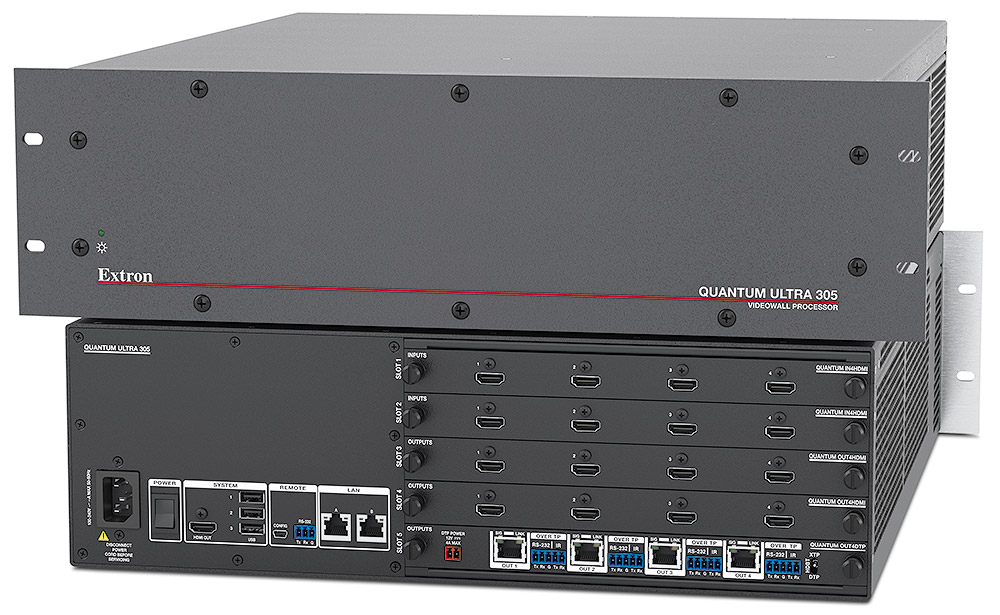
Consist of a 3U card frame with 5 total slots for input and output card combinations
Support a maximum of 16 inputs in a single card frame when configured with digital high-resolution input cards and one output card
Support a maximum of 16 outputs in a single card frame when configured with one input card
Allow large input and output arrays by operating multiple card frames as a single addressable system from the control software
Support multiple input signal formats via input card options
Support multiple output signal formats via output card options
Support field configuration of input and output cards
Be equipped with front-panel LEDs to indicate fan and power supply status
Provide automated notification of critical component failures
Utilize solid-state storage for the operating system
Utilize an embedded operating system
Utilize a unidirectional, dedicated digital high-speed bus designed for sustained, real-time video source transport
Be HDCP-compliant when HDMI input and output cards are used with HDCP-compliant displays
Authenticate and maintain continuous HDCP encryption between input and output devices to ensure quick and proper display of HDCP-encrypted source signals on the videowall
Present a window with an alert message if HDCP-encrypted content is sent to a non-HDCP compliant display
Support 24/7 operation
Take no longer than 90 seconds to boot and display video on all configured outputs
Reboot to the state last shown at shutdown
Support Extended Display Identification Data – EDID and Display Data Channel – DDC data using DVI and HDMI standard
Support factory or custom EDID tables
Automatically maintain efficient use of video bus bandwidth by utilizing no more bandwidth than native resolution on bus for upscaled images and less bandwidth than native resolution for downscaled images
Support horizontal and vertical bezel compensation for flat panel displays
Support horizontal and vertical overlap capability for use in edge-blended applications up to 50% of display resolution
Support output and source rotation in 90-degree increments for portrait or landscape display orientation
Be capable of controlling multiple independent videowalls of varying resolutions and screen orientations from a single processor
Impose no source window positioning restrictions, including overlay and overlap
Allow source windows to be sized to any aspect ratio
Provide up to 30 bit processing for input signals
Provide display of multiple simultaneous VNC sources through multiple VNC serve/client sessions
Provide display of picture files (BMP, PNG and JPG) sourced from the processor’s local storage medium, with support for transparency, keying, and alpha channels
Allow the repeated display of a single source from one input channel at multiple scaled resolutions
Allow the display of internally-generated windows containing static or dynamic text
Allow the display of internally-generated time and date information with support for:
multiple time zones
Daylight savings time
Allow for the display of timer windows with the ability to:
Count up
Count down
Allow the display of user-definable text overlay messages within source windows
Allow the display of customizable borders and titles surrounding source windows, with support for:
Rounded corners
Transparency
Drop shadow
Flashing
Generate dynamically sized test patterns to facilitate display setup
Videowall system shall provide the following security features:
Encrypted data connection between control PC and videowall processor
Digitally signed firmware upgrades
Enabling and disabling of physical and IP ports
Event logging to a file with user-definable maximum size
Operating system shall be password protected with a user definable, changeable password
Videowall processor shall be compatible with the following input and output cards
HDMI input card shall:
Support HDMI video signals
Provide up to four female HDMI Type A connectors
Accept up to four simultaneous inputs, each with pixel clocks up to 165 MHz, supporting resolutions up to 1920x1200 and 2K at 60 Hz
Accept up to two simultaneous inputs, each with pixel clocks up to 300 MHz, supporting resolutions up to 4096x2160 at 30 Hz
Support 4K/30 signals using one connection
Support 4K/60 signal using two or four connections
Support horizontal frequencies from 15 kHz to 135 kHz
Support vertical frequencies from 24 Hz to 120 Hz
Provide 4:4:4 input sampling at up to 10 bits per color
Automatically detect incoming source types
Accept HDCP-encrypted content for presentation on HDCP-compatible displays when used with HDMI output cards.
Allows individual inputs to appear HDCP compliant or non-HDCP compliant to the connected source
Perform downscaling to at least 1/100 of the native source resolution
Provide a locking mechanism to secure HDMI cable connections
HDMI output card which shall:
Support HDMI video signals
Provide up to four female HDMI Type A connectors
Provide up to four simultaneous outputs, each with pixel clocks up to 165 MHz, at resolutions up to 1920x1200 and 2K at 60 Hz
Provide up to two simultaneous outputs, each with pixel clocks up to 300 MHz, at resolutions up to 4096x2160 at 30 Hz
Deliver 4K/30 signals using one connection
Deliver 4K/60 signal using two or four connections
Support vertical frequencies from 23.98 Hz to 60 Hz
Provide a locking mechanism to secure HDMI cable connections
Allow the display of up to 64 source windows across each four-channel output card
Variably scale sources up to to 32 times the output resolution horizontally and vertically
A twisted-pair output card which shall:
Support up to four outputs at distances up to 330 feet (100 meters) over shielded CATx cable
Provide up to four simultaneous outputs, each with pixel clocks up to 165 MHz, at resolutions up to 1920x1200 and 2K at 60 Hz
Provide up to two simultaneous outputs, each with pixel clocks up to 300 MHz, at resolutions up to 4096x2160 at 30 Hz
Deliver 4K/30 signals using one connection
Deliver 4K/60 signal using two or four connections
Support horizontal frequencies from 15 kHz to 100 kHz
Support vertical frequencies from 23.98 Hz to 75 Hz
Allow the display of up to 64 source windows across each four-channel output card
Variably scale sources up to 32 times the output resolution horizontally and vertically
Support remote powering of receivers
Support bi-directional RS-232 and IR insertion for AV device control
Support RS-232 insertion from an Ethernet port
A streaming video decoder card which shall:
Support up to two independently-configurable network connections
Be capable of decoding H-264/AVC, MPEG-2, and MJPEG video streams
Support the video section of ONVIF Profile S
Decode from four 1080p/60 to 16 standard-definition video streams
Decode video streams with no more than 1 second of latency
Provide 4:4:4 input sampling at up to 8 bits per color
Perform downscaling to at least 1/100 of the native source resolution
Remote operation and system control shall:
Be accessible from USB, RS-232, and Ethernet interfaces
Be achieved with direct connection to the processor
Allow control of:
Setting window input source
Window muting
Window priority (layer)
Window position and size adjust
Window presets recall
Recall window border style
Set window text
Video signal presence, by window
Set/view IP settings (IP address, subnet, gateway)
Reset
Hardware failure alert
Allow for independent preset and window control per screen group
Control software shall be included with the videowall processor which shall:
Operate on a PC independent of the videowall processor
Provide network detection for videowall processor discovery
Allow configuration of online processors
Allow manual creation, definition and configuration of processors when offline
Provide a graphical representation of the videowall onto which sources can be dragged and dropped to create window presets
Allow for the creation of custom screen layouts in one or more virtual screen groups
Allow for selection of output parameters, including:
Resolution
Refresh rate
HDCP notification
Output rotation in 90-degree increments
Screen overlap
Mullion compensation
Allow output parameters to be set independently per screen group
Allow creation of source definitions, including:
Physical sources, via auto-detection or manual selection
VNC Sources
Static image sources
Text sources
Timer/Clock sources with:
Timer direction control (count up/count down)
Multiple time zones
Daylight savings time support
Allow for image adjustments of physical sources, including:
Size
Position
Contrast
Brightness
Name
Film mode
Allow for the creation of window presets, with user control over:
Window source
Source size
Window size
Window position
Window layer
Window contents
Window border
Window title
Window overlay
Allow for the creation of 128 window presets per screen group
Provide controls for system EDID management
Allow creation of a password-protected Administrator account for system management
Allow administrator to create password-protected User accounts
Shall be JITC Certified
Approved device shall be the Extron Quantum Ultra 305 (custom part number based on configuration); no alternates or equals
Quantum Ultra 305
Provide a configurable videowall processor that shall support the real-time windowed display of multiple video, graphic, and still image sources on a single or tiled video display
Rack mountable videowall processor for source windowing on single or tiled displays shall:
Consist of a 3U card frame with 5 total slots for input and output card combinations
Support a maximum of 16 inputs in a single card frame when configured with digital high-resolution input cards and one output card
Support a maximum of 16 outputs in a single card frame when configured with one input card
Allow large input and output arrays by operating multiple card frames as a single addressable system from the control software
Support multiple input signal formats via input card options
Support multiple output signal formats via output card options
Support field configuration of input and output cards
Be equipped with front-panel LEDs to indicate fan and power supply status
Provide automated notification of critical component failures
Utilize solid-state storage for the operating system
Utilize an embedded operating system
Utilize a unidirectional, dedicated digital high-speed bus designed for sustained, real-time video source transport
Be HDCP-compliant when HDMI input and output cards are used with HDCP-compliant displays
Authenticate and maintain continuous HDCP encryption between input and output devices to ensure quick and proper display of HDCP-encrypted source signals on the videowall
Present a window with an alert message if HDCP-encrypted content is sent to a non-HDCP compliant display
Support 24/7 operation
Take no longer than 90 seconds to boot and display video on all configured outputs
Reboot to the state last shown at shutdown
Support Extended Display Identification Data – EDID and Display Data Channel – DDC data using DVI and HDMI standard
Support factory or custom EDID tables
Automatically maintain efficient use of video bus bandwidth by utilizing no more bandwidth than native resolution on bus for upscaled images and less bandwidth than native resolution for downscaled images
Support horizontal and vertical bezel compensation for flat panel displays
Support horizontal and vertical overlap capability for use in edge-blended applications up to 50% of display resolution
Support output and source rotation in 90-degree increments for portrait or landscape display orientation
Be capable of controlling multiple independent videowalls of varying resolutions and screen orientations from a single processor
Impose no source window positioning restrictions, including overlay and overlap
Allow source windows to be sized to any aspect ratio
Provide up to 30 bit processing for input signals
Provide display of multiple simultaneous VNC sources through multiple VNC serve/client sessions
Provide display of picture files (BMP, PNG and JPG) sourced from the processor’s local storage medium, with support for transparency, keying, and alpha channels
Allow the repeated display of a single source from one input channel at multiple scaled resolutions
Allow the display of internally-generated windows containing static or dynamic text
Allow the display of internally-generated time and date information with support for:
multiple time zones
Daylight savings time
Allow for the display of timer windows with the ability to:
Count up
Count down
Allow the display of user-definable text overlay messages within source windows
Allow the display of customizable borders and titles surrounding source windows, with support for:
Rounded corners
Transparency
Drop shadow
Flashing
Generate dynamically sized test patterns to facilitate display setup
Videowall system shall provide the following security features:
Encrypted data connection between control PC and videowall processor
Digitally signed firmware upgrades
Enabling and disabling of physical and IP ports
Event logging to a file with user-definable maximum size
Operating system shall be password protected with a user definable, changeable password
Videowall processor shall be compatible with the following input and output cards
HDMI input card shall:
Support HDMI video signals
Provide up to four female HDMI Type A connectors
Accept up to four simultaneous inputs, each with pixel clocks up to 165 MHz, supporting resolutions up to 1920x1200 and 2K at 60 Hz
Accept up to two simultaneous inputs, each with pixel clocks up to 300 MHz, supporting resolutions up to 4096x2160 at 30 Hz
Support 4K/30 signals using one connection
Support 4K/60 signal using two or four connections
Support horizontal frequencies from 15 kHz to 135 kHz
Support vertical frequencies from 24 Hz to 120 Hz
Provide 4:4:4 input sampling at up to 10 bits per color
Automatically detect incoming source types
Accept HDCP-encrypted content for presentation on HDCP-compatible displays when used with HDMI output cards.
Allows individual inputs to appear HDCP compliant or non-HDCP compliant to the connected source
Perform downscaling to at least 1/100 of the native source resolution
Provide a locking mechanism to secure HDMI cable connections
HDMI output card which shall:
Support HDMI video signals
Provide up to four female HDMI Type A connectors
Provide up to four simultaneous outputs, each with pixel clocks up to 165 MHz, at resolutions up to 1920x1200 and 2K at 60 Hz
Provide up to two simultaneous outputs, each with pixel clocks up to 300 MHz, at resolutions up to 4096x2160 at 30 Hz
Deliver 4K/30 signals using one connection
Deliver 4K/60 signal using two or four connections
Support vertical frequencies from 23.98 Hz to 60 Hz
Provide a locking mechanism to secure HDMI cable connections
Allow the display of up to 64 source windows across each four-channel output card
Variably scale sources up to to 32 times the output resolution horizontally and vertically
A twisted-pair output card which shall:
Support up to four outputs at distances up to 330 feet (100 meters) over shielded CATx cable
Provide up to four simultaneous outputs, each with pixel clocks up to 165 MHz, at resolutions up to 1920x1200 and 2K at 60 Hz
Provide up to two simultaneous outputs, each with pixel clocks up to 300 MHz, at resolutions up to 4096x2160 at 30 Hz
Deliver 4K/30 signals using one connection
Deliver 4K/60 signal using two or four connections
Support horizontal frequencies from 15 kHz to 100 kHz
Support vertical frequencies from 23.98 Hz to 75 Hz
Allow the display of up to 64 source windows across each four-channel output card
Variably scale sources up to 32 times the output resolution horizontally and vertically
Support remote powering of receivers
Support bi-directional RS-232 and IR insertion for AV device control
Support RS-232 insertion from an Ethernet port
A streaming video decoder card which shall:
Support up to two independently-configurable network connections
Be capable of decoding H-264/AVC, MPEG-2, and MJPEG video streams
Support the video section of ONVIF Profile S
Decode from four 1080p/60 to 16 standard-definition video streams
Decode video streams with no more than 1 second of latency
Provide 4:4:4 input sampling at up to 8 bits per color
Perform downscaling to at least 1/100 of the native source resolution
Remote operation and system control shall:
Be accessible from USB, RS-232, and Ethernet interfaces
Be achieved with direct connection to the processor
Allow control of:
Setting window input source
Window muting
Window priority (layer)
Window position and size adjust
Window presets recall
Recall window border style
Set window text
Video signal presence, by window
Set/view IP settings (IP address, subnet, gateway)
Reset
Hardware failure alert
Allow for independent preset and window control per screen group
Control software shall be included with the videowall processor which shall:
Operate on a PC independent of the videowall processor
Provide network detection for videowall processor discovery
Allow configuration of online processors
Allow manual creation, definition and configuration of processors when offline
Provide a graphical representation of the videowall onto which sources can be dragged and dropped to create window presets
Allow for the creation of custom screen layouts in one or more virtual screen groups
Allow for selection of output parameters, including:
Resolution
Refresh rate
HDCP notification
Output rotation in 90-degree increments
Screen overlap
Mullion compensation
Allow output parameters to be set independently per screen group
Allow creation of source definitions, including:
Physical sources, via auto-detection or manual selection
VNC Sources
Static image sources
Text sources
Timer/Clock sources with:
Timer direction control (count up/count down)
Multiple time zones
Daylight savings time support
Allow for image adjustments of physical sources, including:
Size
Position
Contrast
Brightness
Name
Film mode
Allow for the creation of window presets, with user control over:
Window source
Source size
Window size
Window position
Window layer
Window contents
Window border
Window title
Window overlay
Allow for the creation of 128 window presets per screen group
Provide controls for system EDID management
Allow creation of a password-protected Administrator account for system management
Allow administrator to create password-protected User accounts
Shall be JITC Certified
Approved device shall be the Extron Quantum Ultra 305 (custom part number based on configuration); no alternates or equals
Quantum Ultra 610
Provide a configurable videowall processor that shall support the real-time windowed display of multiple video, graphic, and still image sources on a single or tiled video display
Rack mountable videowall processor for source windowing on single or tiled displays shall:
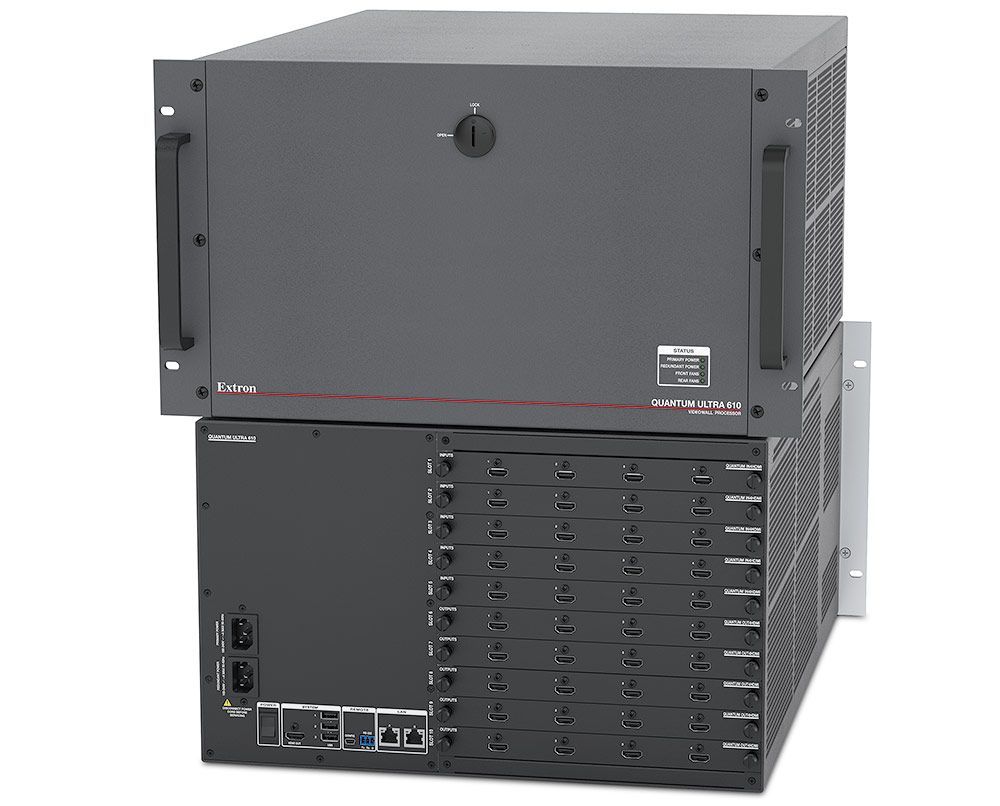
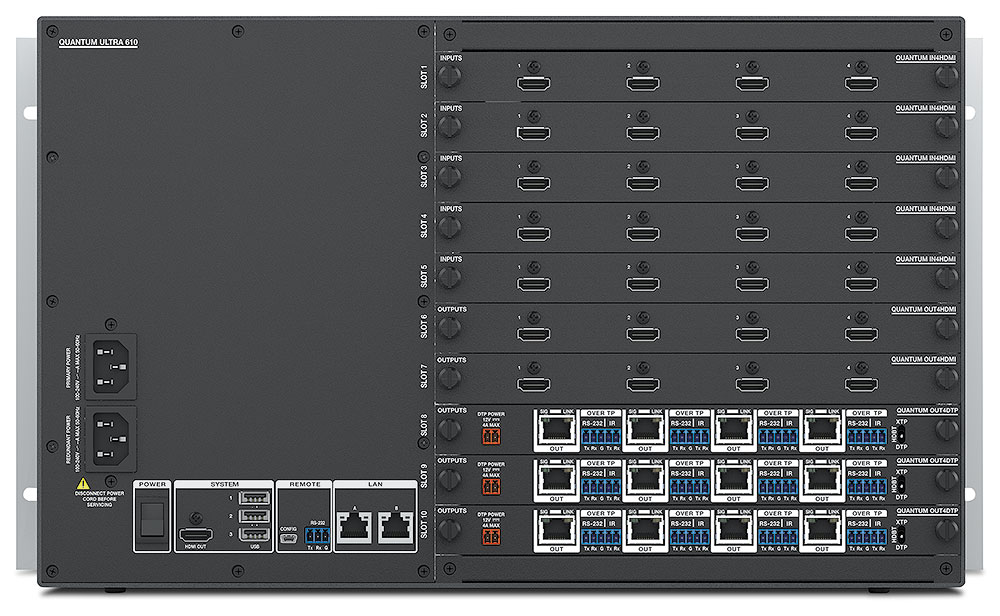
Consist of a 6U card frame with 10 total slots for input and output card combinations
Support a maximum of 36 inputs in a single card frame when configured with digital high resolution input cards and one output card
Support a maximum of 36 outputs in a single card frame when configured with one input card
Allow large input and output arrays by operating multiple card frames as a single addressable system from the control software
Support multiple input signal formats via input card options
Support multiple output signal formats via output card options
Support field configuration of input and output cards
Be equipped with dual redundant, hot swappable power supplies
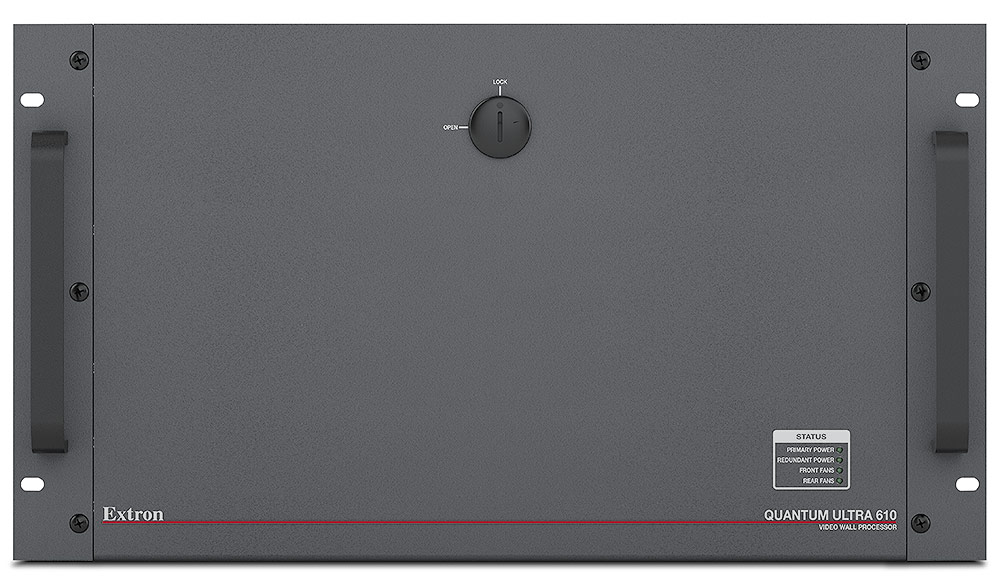
Be equipped with front-panel LEDs to indicate fan and power supply status
Provide automated notification of critical component failures
Utilize solid-state storage for the operating system
Utilize an embedded operating system
Utilize a unidirectional, dedicated digital high-speed bus designed for sustained, real-time video source transport
Be HDCP-compliant when HDMI input and output cards are used with HDCP-compliant displays
Authenticate and maintain continuous HDCP encryption between input and output devices to ensure quick and proper display of HDCP-encrypted source signals on the videowall
Present a window with an alert message if HDCP-encrypted content is sent to a non-HDCP compliant display
Support 24/7 operation
Take no longer than 90 seconds to boot and display video on all configured outputs
Reboot to the state last shown at shutdown
Support Extended Display Identification Data – EDID and Display Data Channel – DDC data using DVI and HDMI standard
Support factory or custom EDID tables
Automatically maintain efficient use of video bus bandwidth by utilizing no more bandwidth than native resolution on bus for upscaled images and less bandwidth than native resolution for downscaled images
Support horizontal and vertical bezel compensation for flat panel displays
Support horizontal and vertical overlap capability for use in edge-blended applications up to 50% of display resolution
Support output and source rotation in 90-degree increments for portrait or landscape display orientation
Be capable of controlling multiple independent videowalls of varying resolutions and screen orientations from a single processor
Impose no source window positioning restrictions, including overlay and overlap
Allow source windows to be sized to any aspect ratio
Provide up to 30 bit processing for input signals
Provide display of multiple simultaneous VNC sources through multiple VNC serve/client sessions
Provide display of picture files (BMP, PNG and JPG) sourced from the processor’s local storage medium, with support for transparency, keying, and alpha channels
Allow the repeated display of a single source from one input channel at multiple scaled resolutions
Allow the display of internally-generated windows containing static or dynamic text
Allow the display of internally-generated time and date information with support for:
multiple time zones
Daylight savings time
Allow for the display of timer windows with the ability to:
Count up
Count down
Allow the display of user-definable text overlay messages within source windows
Allow the display of customizable borders and titles surrounding source windows, with support for:
Rounded corners
Transparency
Drop shadow
Flashing
Generate dynamically sized test patterns to facilitate display setup
Videowall system shall provide the following security features:
Encrypted data connection between control PC and videowall processor
Digitally signed firmware upgrades
Enabling and disabling of physical and IP ports
Event logging to a file with user-definable maximum size
Operating system shall be password protected with a user definable, changeable password
Videowall processor shall be compatible with the following input and output cards
HDMI input card shall:
Support HDMI video signals
Provide up to four female HDMI Type A connectors
Accept up to four simultaneous inputs, each with pixel clocks up to 165 MHz, supporting resolutions up to 1920x1200 and 2K at 60 Hz
Accept up to two simultaneous inputs, each with pixel clocks up to 300 MHz, supporting resolutions up to 4096x2160 at 30 Hz
Support 4K/30 signals using one connection
Support 4K/60 signal using two or four connections
Support horizontal frequencies from 15 kHz to 135 kHz
Support vertical frequencies from 24 Hz to 120 Hz
Provide 4:4:4 input sampling at up to 10 bits per color
Automatically detect incoming source types
Accept HDCP-encrypted content for presentation on HDCP-compatible displays when used with HDMI output cards.
Allows individual inputs to appear HDCP compliant or non-HDCP compliant to the connected source
Perform downscaling to at least 1/100 of the native source resolution
Provide a locking mechanism to secure HDMI cable connections
HDMI output card which shall:
Support HDMI video signals
Provide up to four female HDMI Type A connectors
Provide up to four simultaneous outputs, each with pixel clocks up to 165 MHz, at resolutions up to 1920x1200 and 2K at 60 Hz
Provide up to two simultaneous outputs, each with pixel clocks up to 300 MHz, at resolutions up to 4096x2160 at 30 Hz
Deliver 4K/30 signals using one connection
Deliver 4K/60 signal using two or four connections
Support vertical frequencies from 23.98 Hz to 60 Hz
Provide a locking mechanism to secure HDMI cable connections
Allow the display of up to 64 source windows across each four-channel output card
Variably scale sources up to to 32 times the output resolution horizontally and vertically
A twisted-pair output card which shall:
Support up to four outputs at distances up to 330 feet (100 meters) over shielded CATx cable
Provide up to four simultaneous outputs, each with pixel clocks up to 165 MHz, at resolutions up to 1920x1200 and 2K at 60 Hz
Provide up to two simultaneous outputs, each with pixel clocks up to 300 MHz, at resolutions up to 4096x2160 at 30 Hz
Deliver 4K/30 signals using one connection
Deliver 4K/60 signal using two or four connections
Support horizontal frequencies from 15 kHz to 100 kHz
Support vertical frequencies from 23.98 Hz to 75 Hz
Allow the display of up to 64 source windows across each four-channel output card
Variably scale sources up to 32 times the output resolution horizontally and vertically
Support remote powering of receivers
Support bi-directional RS-232 and IR insertion for AV device control
Support RS-232 insertion from an Ethernet port
A streaming video decoder card which shall:
Support up to two independently-configurable network connections
Be capable of decoding H-264/AVC, MPEG-2, and MJPEG video streams
Support the video section of ONVIF Profile S
Decode from four 1080p/60 to 16 standard-definition video streams
Decode video streams with no more than 1 second of latency
Provide 4:4:4 input sampling at up to 8 bits per color
Perform downscaling to at least 1/100 of the native source resolution
Remote operation and system control shall:
Be accessible from USB, RS-232, and Ethernet interfaces
Be achieved with direct connection to the processor
Allow control of:
Setting window input source
Window muting
Window priority (layer)
Window position and size adjust
Window presets recall
Recall window border style
Set window text
Video signal presence, by window
Set/view IP settings (IP address, subnet, gateway)
Reset
Hardware failure alert
Allow for independent preset and window control per screen group
Control software shall be included with the videowall processor which shall:
Operate on a PC independent of the videowall processor
Provide network detection for videowall processor discovery
Allow configuration of online processors
Allow manual creation, definition and configuration of processors when offline
Provide a graphical representation of the videowall onto which sources can be dragged and dropped to create window presets
Allow for the creation of custom screen layouts in one or more virtual screen groups
Allow for selection of output parameters, including:
Resolution
Refresh rate
HDCP notification
Output rotation in 90-degree increments
Screen overlap
Mullion compensation
Allow output parameters to be set independently per screen group
Allow creation of source definitions, including:
Physical sources, via auto-detection or manual selection
VNC Sources
Static image sources
Text sources
Timer/Clock sources with:
Timer direction control (count up/count down)
Multiple time zones
Daylight savings time support
Allow for image adjustments of physical sources, including:
Size
Position
Contrast
Brightness
Name
Film mode
Allow for the creation of window presets, with user control over:
Window source
Source size
Window size
Window position
Window layer
Window contents
Window border
Window title
Window overlay
Allow for the creation of 128 window presets per screen group
Provide controls for system EDID management
Allow creation of a password-protected Administrator account for system management
Allow administrator to create password-protected User accounts
Shall be JITC Certified
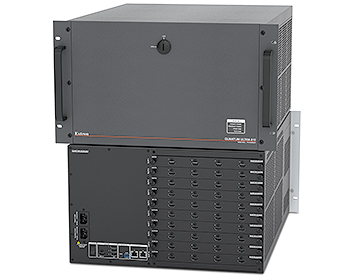
Approved device shall be the Extron Quantum Ultra 610 (custom part number based on configuration); no alternates or equals
Quantum Ultra 610
Provide a configurable videowall processor that shall support the real-time windowed display of multiple video, graphic, and still image sources on a single or tiled video display
Rack mountable videowall processor for source windowing on single or tiled displays shall:
Consist of a 6U card frame with 10 total slots for input and output card combinations
Support a maximum of 36 inputs in a single card frame when configured with digital high resolution input cards and one output card
Support a maximum of 36 outputs in a single card frame when configured with one input card
Allow large input and output arrays by operating multiple card frames as a single addressable system from the control software
Support multiple input signal formats via input card options
Support multiple output signal formats via output card options
Support field configuration of input and output cards
Be equipped with dual redundant, hot swappable power supplies
Be equipped with front-panel LEDs to indicate fan and power supply status
Provide automated notification of critical component failures
Utilize solid-state storage for the operating system
Utilize an embedded operating system
Utilize a unidirectional, dedicated digital high-speed bus designed for sustained, real-time video source transport
Be HDCP-compliant when HDMI input and output cards are used with HDCP-compliant displays
Authenticate and maintain continuous HDCP encryption between input and output devices to ensure quick and proper display of HDCP-encrypted source signals on the videowall
Present a window with an alert message if HDCP-encrypted content is sent to a non-HDCP compliant display
Support 24/7 operation
Take no longer than 90 seconds to boot and display video on all configured outputs
Reboot to the state last shown at shutdown
Support Extended Display Identification Data – EDID and Display Data Channel – DDC data using DVI and HDMI standard
Support factory or custom EDID tables
Automatically maintain efficient use of video bus bandwidth by utilizing no more bandwidth than native resolution on bus for upscaled images and less bandwidth than native resolution for downscaled images
Support horizontal and vertical bezel compensation for flat panel displays
Support horizontal and vertical overlap capability for use in edge-blended applications up to 50% of display resolution
Support output and source rotation in 90-degree increments for portrait or landscape display orientation
Be capable of controlling multiple independent videowalls of varying resolutions and screen orientations from a single processor
Impose no source window positioning restrictions, including overlay and overlap
Allow source windows to be sized to any aspect ratio
Provide up to 30 bit processing for input signals
Provide display of multiple simultaneous VNC sources through multiple VNC serve/client sessions
Provide display of picture files (BMP, PNG and JPG) sourced from the processor’s local storage medium, with support for transparency, keying, and alpha channels
Allow the repeated display of a single source from one input channel at multiple scaled resolutions
Allow the display of internally-generated windows containing static or dynamic text
Allow the display of internally-generated time and date information with support for:
multiple time zones
Daylight savings time
Allow for the display of timer windows with the ability to:
Count up
Count down
Allow the display of user-definable text overlay messages within source windows
Allow the display of customizable borders and titles surrounding source windows, with support for:
Rounded corners
Transparency
Drop shadow
Flashing
Generate dynamically sized test patterns to facilitate display setup
Videowall system shall provide the following security features:
Encrypted data connection between control PC and videowall processor
Digitally signed firmware upgrades
Enabling and disabling of physical and IP ports
Event logging to a file with user-definable maximum size
Operating system shall be password protected with a user definable, changeable password
Videowall processor shall be compatible with the following input and output cards
HDMI input card shall:
Support HDMI video signals
Provide up to four female HDMI Type A connectors
Accept up to four simultaneous inputs, each with pixel clocks up to 165 MHz, supporting resolutions up to 1920x1200 and 2K at 60 Hz
Accept up to two simultaneous inputs, each with pixel clocks up to 300 MHz, supporting resolutions up to 4096x2160 at 30 Hz
Support 4K/30 signals using one connection
Support 4K/60 signal using two or four connections
Support horizontal frequencies from 15 kHz to 135 kHz
Support vertical frequencies from 24 Hz to 120 Hz
Provide 4:4:4 input sampling at up to 10 bits per color
Automatically detect incoming source types
Accept HDCP-encrypted content for presentation on HDCP-compatible displays when used with HDMI output cards.
Allows individual inputs to appear HDCP compliant or non-HDCP compliant to the connected source
Perform downscaling to at least 1/100 of the native source resolution
Provide a locking mechanism to secure HDMI cable connections
HDMI output card which shall:
Support HDMI video signals
Provide up to four female HDMI Type A connectors
Provide up to four simultaneous outputs, each with pixel clocks up to 165 MHz, at resolutions up to 1920x1200 and 2K at 60 Hz
Provide up to two simultaneous outputs, each with pixel clocks up to 300 MHz, at resolutions up to 4096x2160 at 30 Hz
Deliver 4K/30 signals using one connection
Deliver 4K/60 signal using two or four connections
Support vertical frequencies from 23.98 Hz to 60 Hz
Provide a locking mechanism to secure HDMI cable connections
Allow the display of up to 64 source windows across each four-channel output card
Variably scale sources up to to 32 times the output resolution horizontally and vertically
A twisted-pair output card which shall:
Support up to four outputs at distances up to 330 feet (100 meters) over shielded CATx cable
Provide up to four simultaneous outputs, each with pixel clocks up to 165 MHz, at resolutions up to 1920x1200 and 2K at 60 Hz
Provide up to two simultaneous outputs, each with pixel clocks up to 300 MHz, at resolutions up to 4096x2160 at 30 Hz
Deliver 4K/30 signals using one connection
Deliver 4K/60 signal using two or four connections
Support horizontal frequencies from 15 kHz to 100 kHz
Support vertical frequencies from 23.98 Hz to 75 Hz
Allow the display of up to 64 source windows across each four-channel output card
Variably scale sources up to 32 times the output resolution horizontally and vertically
Support remote powering of receivers
Support bi-directional RS-232 and IR insertion for AV device control
Support RS-232 insertion from an Ethernet port
A streaming video decoder card which shall:
Support up to two independently-configurable network connections
Be capable of decoding H-264/AVC, MPEG-2, and MJPEG video streams
Support the video section of ONVIF Profile S
Decode from four 1080p/60 to 16 standard-definition video streams
Decode video streams with no more than 1 second of latency
Provide 4:4:4 input sampling at up to 8 bits per color
Perform downscaling to at least 1/100 of the native source resolution
Remote operation and system control shall:
Be accessible from USB, RS-232, and Ethernet interfaces
Be achieved with direct connection to the processor
Allow control of:
Setting window input source
Window muting
Window priority (layer)
Window position and size adjust
Window presets recall
Recall window border style
Set window text
Video signal presence, by window
Set/view IP settings (IP address, subnet, gateway)
Reset
Hardware failure alert
Allow for independent preset and window control per screen group
Control software shall be included with the videowall processor which shall:
Operate on a PC independent of the videowall processor
Provide network detection for videowall processor discovery
Allow configuration of online processors
Allow manual creation, definition and configuration of processors when offline
Provide a graphical representation of the videowall onto which sources can be dragged and dropped to create window presets
Allow for the creation of custom screen layouts in one or more virtual screen groups
Allow for selection of output parameters, including:
Resolution
Refresh rate
HDCP notification
Output rotation in 90-degree increments
Screen overlap
Mullion compensation
Allow output parameters to be set independently per screen group
Allow creation of source definitions, including:
Physical sources, via auto-detection or manual selection
VNC Sources
Static image sources
Text sources
Timer/Clock sources with:
Timer direction control (count up/count down)
Multiple time zones
Daylight savings time support
Allow for image adjustments of physical sources, including:
Size
Position
Contrast
Brightness
Name
Film mode
Allow for the creation of window presets, with user control over:
Window source
Source size
Window size
Window position
Window layer
Window contents
Window border
Window title
Window overlay
Allow for the creation of 128 window presets per screen group
Provide controls for system EDID management
Allow creation of a password-protected Administrator account for system management
Allow administrator to create password-protected User accounts
Shall be JITC Certified
Approved device shall be the Extron Quantum Ultra 610 (custom part number based on configuration); no alternates or equals


















 Chrome
 Firefox
 Edge
Edge
 Safari